
Sources for Tracing Former Logan County Property Owners
Dates decide the right starting source. Logan County's Clerk, Archives, and KDLA each describe different record spans for the county. Treat them separately, not as one continuous span.
| Source | Years It Covers | Where Held | What It Shows |
|---|---|---|---|
| eCCLIX | 1980 to current | Logan County Clerk online route | Indexed recent transfers and recording leads. |
| Clerk instruments | From 1798 | County Clerk | Recorded deeds and related instruments. |
| Grantor-grantee index | 1792 to present | Logan County Archives description | Name trail, subject to index limits. |
| KDLA deed microfilm | 1792-1803; 1806-2017 | KDLA and local access | Images of deed-book runs with a documented gap. |
| Deed and survey abstracts | Deeds 1792-1819; surveys from 1792 into late 1800s | Logan County Archives | Book-page, owner, acreage, watercourse, and date leads. |
Begin with eCCLIX for the recent chain. Then move to the Clerk and Archives for older books, and turn to KDLA when a microfilm series or state-held inventory can supply the missing link.
The Source-of-Title Clue for Logan County Previous Owners
The source-of-title clause is your bridge. Copy that book-page reference exactly. Record the grantor's exact name, both instrument dates, and the full legal description. Read the cited deed itself before stepping back.
A PVA sales row alone is not enough. A sale can be marked "Multiple Properties," carry a nominal amount, or reflect a correction. The card's book-page still helps, because it leads to the Clerk's recorded document, where the conveyed parcel and the parties can be tested.
Walking a Logan County Deed Chain Backward
Work backward, reversing the transfer sequence. Match the legal description rather than a similar surname or street address.
- Find the present owner's purchase deed and verify parcel, subdivision, lot, acreage, or survey calls.
- Enter its transfer date, recording date, deed type, book-page, grantor, grantee, and consideration in a chronology.
- Search the grantor as an earlier grantee, then compare that deed's land description and source of title.
- Repeat through 1980, then continue with the Clerk's books, Archives indexes, and KDLA microfilm.
- Grantor
- The party conveying the stated interest.
- Grantee
- The party receiving that interest.
- Chain of title
- The linked sequence of conveyances affecting the same land.
- Reverse index
- An index route organized from grantee names back to earlier acquisitions.
- Warranty and quitclaim
- Different deed forms whose written warranties must be read, not assumed.
Extending Logan County Past Owners Through Local Archives
Logan County's archive culture is unusually local. The county Archives keeps its records "at home." Its collections include deed indexes, deed and survey abstracts, tax lists, wills, probate packets, loose deeds, mortgages, and lis pendens.
The Archives record list is the best first inventory once a chain leaves the web. Several spans of the tax lists are nonindexed or nonsearchable. A no-result can therefore mean there is no index, not that no ownership evidence exists.
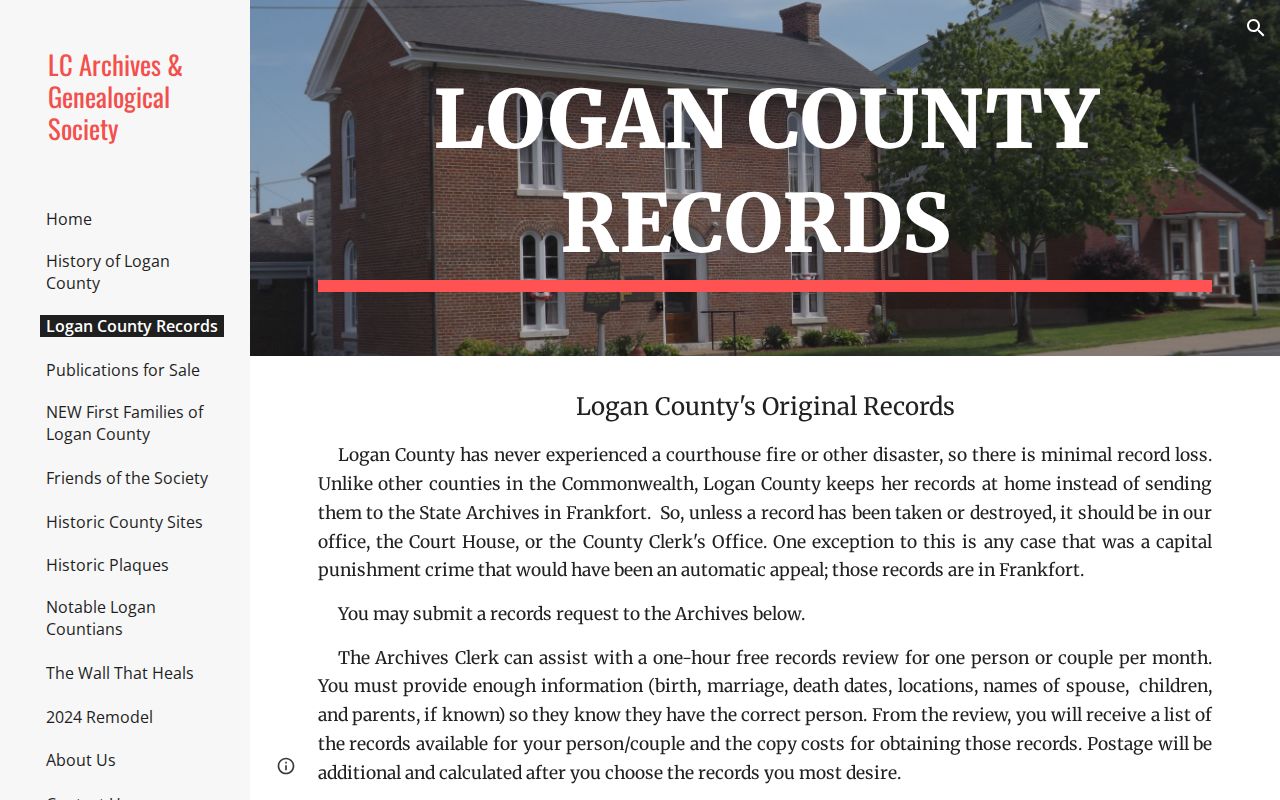
An address alone makes a weak request. Archives staff can search far better when a request names a person, a place or watercourse, a date range, and any known book-page reference.
When Probate Breaks the Logan County Owner Chain
A death can open a gap between deeds. Look for a probated will recorded with its order. An executor or administrator deed can also fill the gap. So can a survivorship deed, a court-approved sale, or an affidavit of descent under KRS 382.120.
Identify the probate case through Logan District Court or the Circuit Clerk. Then find the recorded instrument against the land at the County Clerk. Original wills run from 1795 forward. Abstracts extend through 1966, and probate settlement packets cover 1795 through 1978. A probate docket alone does not prove title.
Historic Names That Hide Former Logan County Owners
Old deeds rarely cite a modern parcel number. Instead they may describe a watercourse, a road, an adjoining owner, a military warrant, a school district, or a former county. Logan County formed in 1792 from western Lincoln County. Later boundary exchanges mean a trail may cross jurisdictions.
Auburn offers a concrete street crosswalk. Church became College, Pond became Perkins, Depot became Caldwell, and Pearl became Spring south of town. The historic grid followed the Bowling Green-Russellville Road, Middleton Road, the railroad, and Black Lick Creek, but these are search clues, not a modern boundary map.
Prior Liens and Releases Along the Logan County Chain
Debt records travel with each transfer. Track mortgages, assignments, vendor's liens, judgment liens, and later releases under both parties. A satisfaction may sit in a separate book. It can also be indexed under the lender. Easements, covenants, leases, and plats can persist after an owner changes, but record the parcel link without treating an encumbrance or lease as an ownership transfer.
Early Logan County Owners Before the Local Books
The Archives traces its index description to 1792. Earlier Lincoln County entries route to the Kentucky Secretary of State land office, where land warrants, entries, surveys, and patents can each identify an early claimant in its own way.
Survey abstracts for Books A-G are rich. They retain owner, acreage, watercourse, date, and book-page clues. The abstract points to the original survey or deed. Then connect its calls to later conveyances. Never call a patent holder the former owner of today's parcel without completing that chain.
How Far Back Logan County Ownership Records Reach
Online access through eCCLIX begins in 1980. The Clerk describes recorded instruments reaching back to 1798, while the Archives describes a grantor-grantee index from 1792. KDLA lists discontinuous deed microfilm and other land series. These layers can carry a chain close to county formation, but a complete result still depends on the surviving, indexed source for the exact tract.
The March 2025 Fiscal Court minutes record a $38,000 KDLA grant. It funds preservation of recording books at the Archives. Funding is not the same as online access. Ask whether the item you need is an original, a microfilm image, an abstract, or a scan.
Use the chain lawfully. Former-owner research supports house history, estate work, and property diligence. Never use these records to stalk, harass, or expose a living person.