
Fields That Build a Logan County Property Tax Record
Two offices shape a Logan County property tax record. The Logan County PVA handles identification and valuation of real property. The Logan County Sheriff then collects the bill. Pull a parcel report and you may see the account and parcel identifiers, the situs, the owner of record and mailing address, a description, property class, tax district and rate, land and improvement values, exemptions, special assessments, a sales table, and a tax-bill handoff. Check the report date, too. Every one of those fields moves on its own schedule.
| Field | What It Shows | Where |
|---|---|---|
| Assessment | Land, improvement, and total value for the stated year | Logan County PVA record |
| Property identity | Parcel, account, situs, class, and description | Logan County PVA record |
| District and rate | The tax district and displayed rate tied to the parcel | PVA report and tax bill |
| Bill status | Current collection amount, timing, and payment handling | Logan County Sheriff |
| Delinquency | Certificate, charges, notices, sale, assignment, or release | Sheriff, County Clerk, and court files |
Do not confuse the assessment with the bill. The sale price is not the value either. Kentucky real property gets assessed under a fair-cash-value framework, yet the final tax bill also turns on which districts apply and what rates they set. Even a deed's consideration can mislead, since some recorded transfers were never open-market sales. A clean comparison in Logan County keeps three dates separate: the value year on the assessment, the bill year, and the deed date in the deed records. Mix them together and the numbers stop meaning anything.
Logan County's PVA Search Has a Documented Gap
The county points its property search to qPublic, where Schneider's public interface lets you query by name, address, parcel ID, alternate ID, or all fields at once. Beyond that, the Logan-specific results screen stays out of public view. Its field labels, coverage dates, export options, and pagination are simply not published for inspection, so treat any description of them as guesswork rather than fact about Logan County property records.
| Observed control | Use | Limit |
|---|---|---|
| State and county/area | Select Kentucky and Logan | Global interface observed |
| Name | Find an assessment by listed owner | Live Logan result not captured |
| Address | Start with the situs | Normalize road aliases first |
| Parcel or alternate ID | Use the strongest property key | Format was not verified |
One Public Service Commission exhibit does include a sample PVA report. It lists owner, mailing, and situs fields, plus account, class, tax district and rate, value, special assessments, sales, and map data. Treat it as a field inventory only. It is not a live Logan County parcel card.
Read the Logan County Collection Calendar Before Paying
Timing drives everything in Logan County tax collection. The Sheriff's official page says bills go out near the end of September. Collection opens October 1. Pay by November 1 and you get a 2 percent discount. Face amount runs through December 31. A 5 percent penalty applies through January 31, and a 21 percent penalty kicks in after February 1. Those windows shift each year. Confirm the current calendar before you act on any tax bill. Payment method matters too. The Sheriff accepts cash, checks, money orders, certified checks, and credit cards. Card payments carry a separate fee. Partial payments are not accepted. Mailed receipts require a written-reminder form. Postmark treatment is spelled out on the same page. A payment button alone does not mean the Sheriff offers a parcel-level public property search. The Sheriff tax-collection capture gives a visual walkthrough of these official instructions.

That image reflects the official source page for timing and payment rules. Always verify the live page for the tax year you are researching.
Note: Mailed, posted, paid, and recorded are separate events, so retain the date shown by each source.
Follow a Logan County Bill From Parcel to Receipt
A solid Logan County property tax search carries one identifier through every stage, from parcel card to receipt. An owner name alone is a weak anchor. Spellings drift and ownership changes hands.
- Search the PVA path by situs or parcel and record the account, tax district, value year, and report date.
- Use the Sheriff's current instructions to locate or request the matching bill and confirm the tax year.
- Compare the owner, parcel, and district before paying; ask the office when a current account endpoint is not exposed.
- Save the receipt or status with its retrieval date, then check the County Clerk if delinquency created a recorded certificate or release.
- Fair cash value
- The Kentucky assessment standard described by the Department of Revenue.
- Tax district
- The jurisdictional grouping used with rates on the parcel and bill.
- Certificate of delinquency
- The instrument created after unpaid tax moves into the statutory collection process.
- Exemption
- A qualifying reduction applied through the PVA, subject to current state rules.
When Logan County Property Tax Becomes Delinquent
When a Logan County tax bill goes unpaid, the process moves into state territory. The Kentucky Department of Revenue delinquency guide lays out certificates of delinquency, required notices, added charges, and the timing of sales. For any Logan parcel, record the tax year, certificate number, face tax, interest and penalties, notice date, purchaser or assignment, and any release. The county publishes no complete online delinquency search, so when the web trail ends, call the Sheriff or the Clerk directly. A certificate can matter greatly for title research. It is not proof of foreclosure, though. Court filings, assignments, releases, and a later deed can all change the outcome, so match every event by parcel number or legal description rather than by a taxpayer's name alone.
Kentucky's Assessment Calendar Controls Logan Reviews
Every Logan County assessment appeal runs on a statewide clock. The Kentucky property-tax calendar opens with the January 1 assessment date. From there it moves through the inspection period, the PVA conference, local-board review, notice of the board's ruling, and finally the Kentucky Board of Tax Appeals. Those dates can shift from year to year. The DOR page itself is the authoritative source for the current cycle.
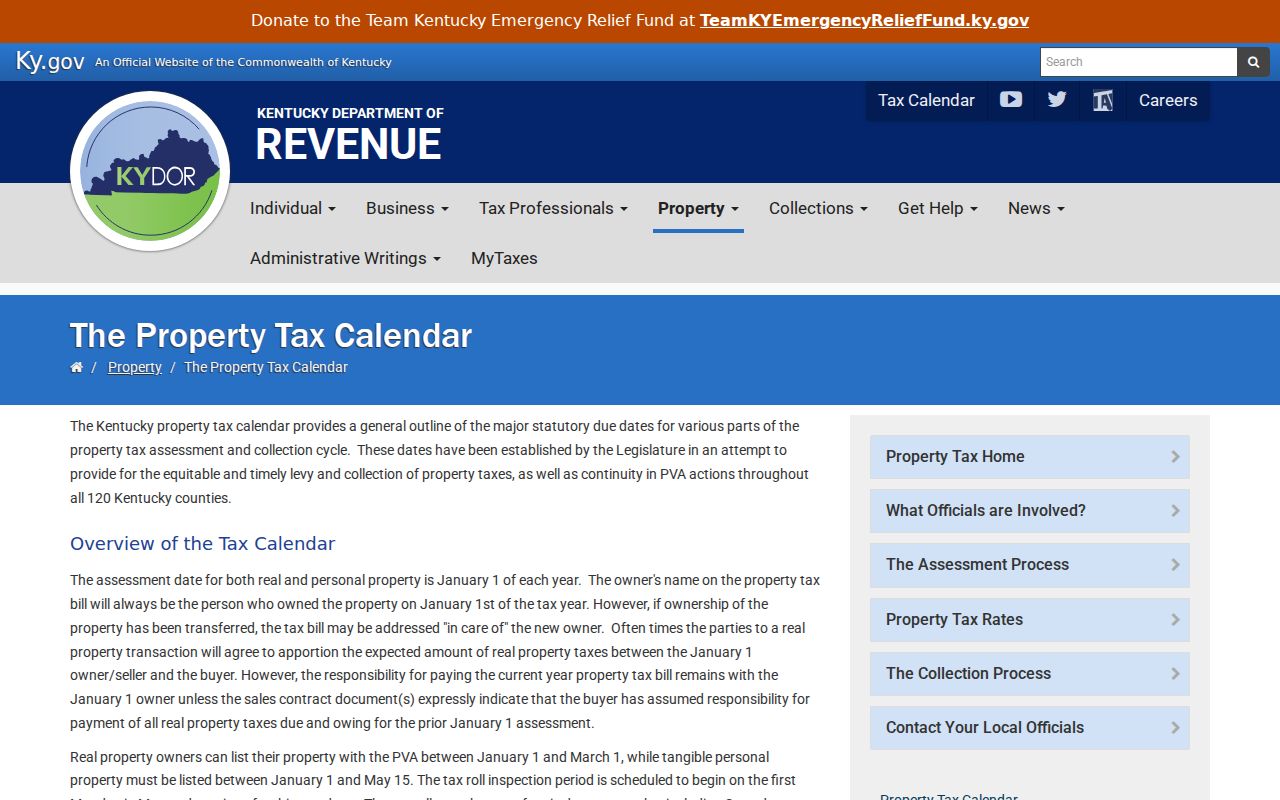
The state calendar supplies the procedure, while the Logan PVA supplies the parcel record and the local conference details.
Match a Logan County Tax Bill to Its Assessment
Go to the PVA first, then the Sheriff. The two offices hold different halves of the Logan County property tax record. If an online account will not load, call the PVA at (270) 726-8334 for assessment fields. Ask the Sheriff for current collection instructions. When a record is public but simply not posted, request an electronic copy or an office inspection under the Kentucky Open Records Act. That statute gives you a formal path to the parcel data.
- Record the parcel, account, situs, owner, and assessment year from the PVA source.
- Request the same tax year's bill or status from the Sheriff and compare its parcel and district.
- Check whether an exemption or special assessment changes the taxable amount.
- If unpaid, trace the certificate and any later assignment, release, or court action.
- Assessed value
- The dated PVA value used in the tax system.
- Rate or levy
- The applied rate associated with the relevant taxing district.
- Homestead exemption
- Relief administered through the PVA for a person who meets current Kentucky eligibility rules.
- Tax lien
- A claim arising from unpaid tax that requires document-level verification.
Logan County Exemption Questions Start at the PVA
Exemption questions in Logan County begin at the PVA office. Kentucky DOR residential guidance covers homestead eligibility categories. It also covers the proof of age or disability an applicant must show, and application through the local PVA. Confirm the exact form and the current biennial amount when you apply. Remember that an exemption changes the taxable calculation only. It does not rewrite the recorded deed or prove anyone's occupancy. For a Logan County property tax record, ask three things. Which year does the exemption first apply? What proof does the office require? Does the parcel card yet show the approved change? Keep the decision notice filed with the matching value year and tax bill.
Contest a Logan County Assessment in the Right Sequence
Every challenge starts with a conference at the Logan County PVA, held during the inspection period set by the state calendar. Come prepared. Good evidence names the parcel and the assessment year. It might include comparable sales, photographs, repair records, acreage or classification facts, or a licensed appraisal when the numbers justify one. If the conference does not settle the question, the owner can take the dispute to the local board. From there, one more step remains open. An appeal may go to the Kentucky Board of Tax Appeals, provided it is filed within the applicable deadline after the board mails its ruling.
Protect the deadline. Check the current DOR calendar and Logan PVA instructions before filing; a tax-payment dispute does not replace the required assessment conference and appeal sequence.
Assessed value and market value pull from different evidence, and a sale price is its own creature again. The Logan County property value page sorts out those distinctions. This page stays with the path from assessment to tax bill.